There are many big medieval festivals scattered around Tuscany. All have roots back many hundreds of years, but most of the modern reincarnations date from earlier this century under the auspices of Mussolini. The most famous palio is the one that takes place in Siena (twice a year) where the central square is transformed into a racecourse for a furious horse race with jockeys riding bareback on a horse representing the various contradas (quarters) of the city. There is much rivalry and sometimes a bit of violence too!
Other enjoyable celebrations include a rather boisterous antique version of soccer in Florence. From what I can see, the ball is almost irrelevent and it is just an excuse for a big punch-up. Sansepolcro hosts a big crossbow shooting competition, with the local team pitted against visitors from Gubbio (which then returns the compliment). As I have already mentioned, Anghiari stages a gruelling road race up its steep hill, while Caprese Michelangelo contents itself with a more sedate chestnut festival in October.
For me the most entertaining festival is that of the Giostra del Saracino in Arezzo. This is a jousting competition held in the main square where riders with lances score points on a small target fixed to a spinning mannequin, complete with ball and chain! Again the various quarters of the city compete for the prize of the golden lance. Much skill is needed, and the horses are fantastic.
Showing posts with label Traditions. Show all posts
Showing posts with label Traditions. Show all posts
Sunday, 28 November 2010

Saturday, 27 November 2010
Anghiari Palio
Anghiari is extraordinarily picturesque, but is only really famous due to the battle that took place in the plain below on 29 June 1440. This battle saw the Milanese take on the forces of Venice and Florence (under the Papal banner). Despite a huge amount of pomp and chest-puffing, the battle itself was a bit of a damp squib with no proper engagement, and only one man died (accidentally falling off his horse!). Leonardo da Vinci painted a large fresco depicting the battle in the Palazzo Vecchio in Florence but this has now been lost and only a few cartoons exist which show a little of what the finished masterpiece would have been like.
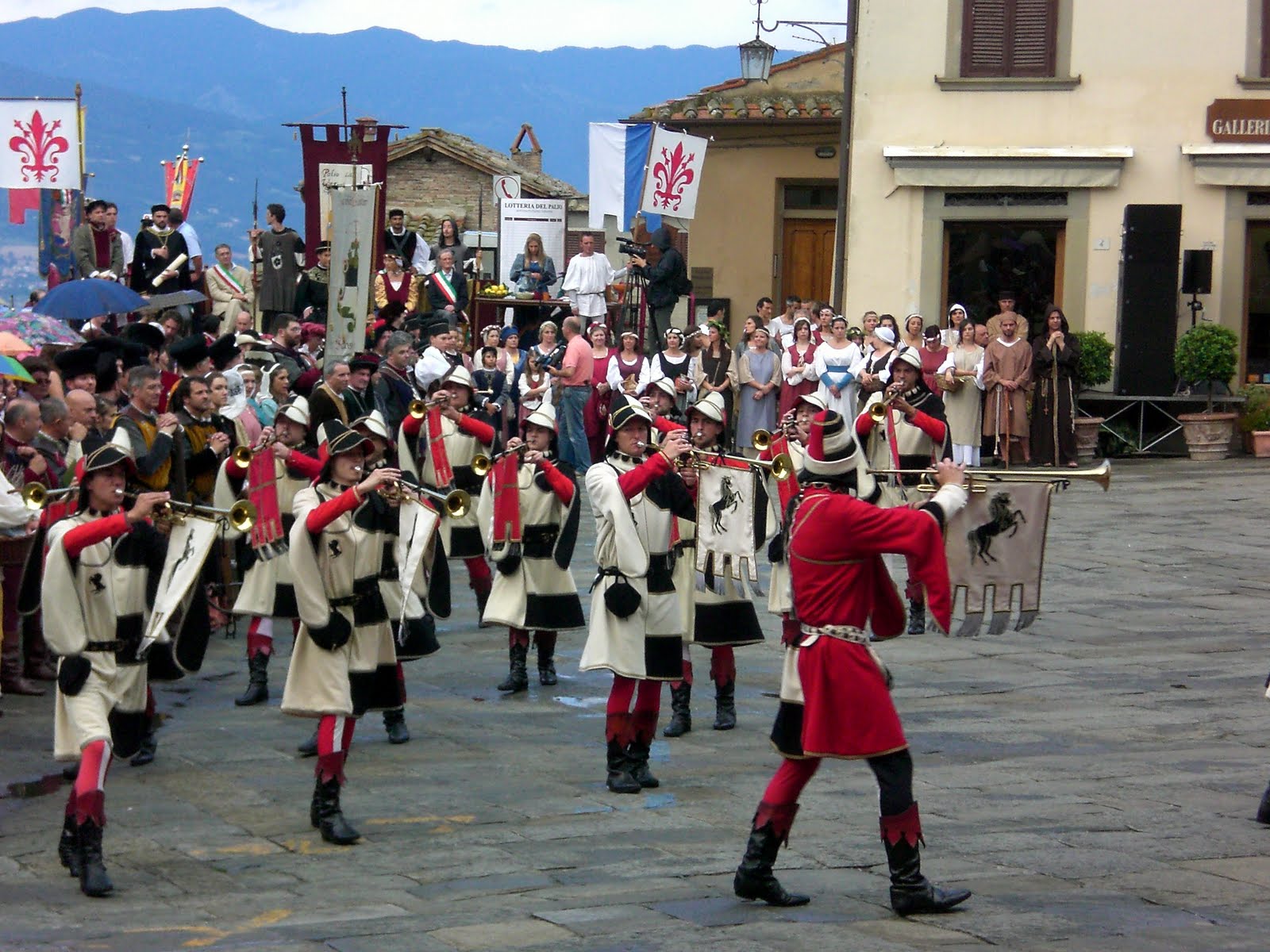
Today the battle is cause for celebration and is marked with a foot race from the battle site in the valley up the incredibly steep hill to the town square - pretty tough going especially in the summer heat. It is also an excuse for pageantry and revelry with townsfolk dressing up in medieval costume, and entertained by the trumpets and drums of re-enactment groups from all over Tuscany, including the traditional football players from Florence, the band from Arezzo and the flag-throwers of Sansepolcro. And then a huge feast to finish of precedings at Castello di Sorci, a great restaurant in what used to be a stronghold of local condottiero (mercenary) Baldaccio. Definitely a great day out!


Today the battle is cause for celebration and is marked with a foot race from the battle site in the valley up the incredibly steep hill to the town square - pretty tough going especially in the summer heat. It is also an excuse for pageantry and revelry with townsfolk dressing up in medieval costume, and entertained by the trumpets and drums of re-enactment groups from all over Tuscany, including the traditional football players from Florence, the band from Arezzo and the flag-throwers of Sansepolcro. And then a huge feast to finish of precedings at Castello di Sorci, a great restaurant in what used to be a stronghold of local condottiero (mercenary) Baldaccio. Definitely a great day out!



Sunday, 31 January 2010
Carnevale!
Although, technically, the Italian carnival season started on January 7th, immediately after Befana, it is this weekend that many of the comuni start their celebrations in earnest. And to celebrate, I though I would show you a mouth-watering plate of frittelle, the traditional carnival sweet. They are basically little sweet fritters that come in many varieties. These in the picture are stuffed with creme patissiere. Very yummy for breakfast with coffee :)

Carnival is an ancient festival connected with the Catholic Church. During the six-week period of Lent, Catholics prepare for the commemoration of the death and resurrection of Jesus by repenting their sins and living austerely. Traditionally, Carnival which leads up to Lent was a period when people used up all the luxury food items and had parties to get it out of their system before Lent began. Ash Wednesday, the first day of Lent falls on 17 February this year, so until then 'let the good times roll!'
I am planning to visit one of the local Carnivals next weekend, so should have some pictures to post then.

Carnival is an ancient festival connected with the Catholic Church. During the six-week period of Lent, Catholics prepare for the commemoration of the death and resurrection of Jesus by repenting their sins and living austerely. Traditionally, Carnival which leads up to Lent was a period when people used up all the luxury food items and had parties to get it out of their system before Lent began. Ash Wednesday, the first day of Lent falls on 17 February this year, so until then 'let the good times roll!'
I am planning to visit one of the local Carnivals next weekend, so should have some pictures to post then.
Wednesday, 6 January 2010
La Befana vien da notte ...
Befana is the traditional Italian Christmas celebration which takes place on the 6th January, the feast of the Epiphany. Tradition says that at night on the 5th January, an old woman or witch, Befana, comes into your house and fills children's stockings with either sweets and gifts for the good or coal (carbone)for the bad. If she sees you while she is visiting she will hit you with her broomstick (manico di scopa)which she also uses as a form of transport. For anglo-saxons, the effect is like a weird mix of Christmas and Hallowe'en as the shops are full of witches on broomsticks. In fact, it is believed that the festival is older than either of those and dates back to pre-christian Roman times. Later, the festival was christianised and Befana becomes part of the story of the Epiphany as an old woman who showed hospitality to the three Kings or Magi on their way to find the baby Jesus.
I can happily confirm that I woke up this morning to find a mixture of sweets (Kinder assortment ... yum) and coal in my stocking. The coal was lovely ... mint flavoured ;)
I can happily confirm that I woke up this morning to find a mixture of sweets (Kinder assortment ... yum) and coal in my stocking. The coal was lovely ... mint flavoured ;)
Subscribe to:
Posts (Atom)